





















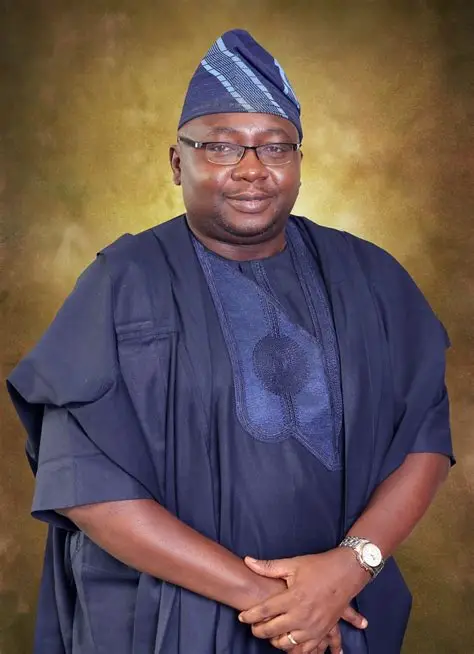
From frontline to sideline: Adelabu’s political story
By Prince Muji Armstrong-Bello
Politics is not about occupying positions only. It is about building trust, sustaining loyalty and maintaining a political structure capable of surviving both victory and defeat.
That is why the latest political development around former Minister of Power, Chief Adebayo Adelabu, deserves more than passing attention.
On Monday, September 21, a political movement associated with Adelabu’s former aide and loyalist, Ajiboye Sangogade, popularly known as Boye Nation, formally moved from the All Progressives Congress (APC) into the Allied Peoples Movement (APM). Reports said the group comprised supporters drawn from several local government areas and was received by Governor Seyi Makinde at a political event in Ibadan.
Whether Adelabu personally authorised the movement is a separate question, and there is no sufficient public evidence to establish that.
But politically, the consequences of the event may be harder for Adelabu to escape than the question of who authorised it.
THE TRUST QUESTION
For a politician who has returned to the APC after previously leaving the party, subsequently received a major federal appointment and again contested for the party’s governorship ticket, the latest development inevitably raises questions about political loyalty and reliability.
Politics is built on trust.
Party leaders need to know whether a politician who loses a contest will remain within the political family, help rebuild the structure and support the eventual candidate — or whether his political network will begin looking elsewhere.
That is why yesterday’s movement into APM could create a new perception problem for Adelabu inside the APC.
Even if he did not personally instruct his supporters to leave, he may still have to answer the political question of why a significant part of the structure associated with him has found accommodation in a rival political platform.
In politics, perception can sometimes become almost as consequential as formal allegiance.
THE HISTORY MATTERS
The present development cannot be understood without examining Adelabu’s political journey.
In the build-up to the 2019 governorship election, the APC’s succession politics in Oyo was complicated by competing interests, including the position initially associated with former Governor Abiola Ajimobi and the candidacy of Joseph Tegbe.
Adelabu eventually emerged as the APC candidate and became the party’s principal challenger to Seyi Makinde.
The result demonstrated substantial electoral strength.
Adelabu secured 357,982 votes, representing 39.04 per cent of valid votes, while Makinde won with 515,621 votes.
That result placed Adelabu firmly on the frontline of Oyo politics. But four years later, the political picture changed dramatically.
After losing the APC governorship primary to Teslim Folarin, Adelabu left the APC and contested the 2023 governorship election on the Accord platform.
This time he polled only 38,358 votes, finishing third behind Makinde’s 563,756 and Folarin’s 256,685.
The figures tell their own story.
From 357,982 votes in 2019 to 38,358 in 2023 is a fall of about 89 per cent.
That does not, by itself, prove the disappearance of a politician’s influence. Elections are affected by party structure, alliances, candidates, incumbency, campaign organisation and many other factors.
But it is nevertheless an important measure of electoral reach.
THE MINISTERIAL COMEBACK
Adelabu’s political fortunes subsequently changed again.
His appointment by President Bola Ahmed Tinubu as Minister of Power returned him to the national political mainstream and, by extension, strengthened his position within the APC.
It was a remarkable political comeback.
The politician who had left the APC after losing its 2023 governorship ticket was back at the centre of the ruling party’s national administration.
That opportunity also gave Adelabu another chance to rebuild his political relevance in Oyo.
He returned to the APC fold and again sought the governorship ticket for 2027.
But history repeated itself in one important respect. He lost the nomination.
And this time there was no alternative governorship ballot waiting for him.
2027: NO TICKET, NO BALLOT
With Senator Sharafadeen Alli emerging as the APC governorship candidate, Adelabu’s name will not appear on the 2027 Oyo governorship ballot.
That fact alone represents a significant change from 2019.
In 2019, Adelabu was the APC’s standard-bearer.
In 2023, although he had left APC, he was still a governorship candidate on the Accord platform.
In 2027, he is neither the APC candidate nor a candidate on another platform. His political visibility has therefore entered a different phase.
And that is where the September 21 APM development becomes particularly important.
WHEN FOLLOWERS BEGIN TO MOVE
A politician can lose an election and remain influential. He can lose a primary and remain relevant. But when the political structure associated with him begins to move independently, the calculation changes.
The APM event is therefore not simply about the number of people who defected. It raises the deeper question of political ownership.
If a politician’s followers can move from his party into a rival political platform immediately after he loses a party nomination, what does that say about the cohesion of the political structure around him?
And if the politician himself remains in APC while people identified with his political network are welcomed into APM by the governor who will be one of the principal figures in the 2027 political contest, the optics become even more complicated.
THE APC TRUST DEFICIT
This is where Adelabu’s immediate political problem may become more serious. APC leaders may reasonably ask a straightforward question: Can Adelabu be relied upon as a committed party man after losing the governorship ticket?
That question does not require a formal accusation against him. It is a question that naturally arises from the sequence of events.
After the 2023 APC primary, he left the party and contested under Accord. After his return to APC and subsequent ministerial appointment, he again pursued the governorship ticket. After losing the 2027 nomination, a political network associated with him has now moved into APM.
For party leaders, the concern may not simply be what Adelabu personally does.
It may be whether the political network surrounding him can remain aligned with the APC when his personal political ambition is not accommodated. That could produce a trust deficit. And in party politics, trust is political capital.
THE QUESTION OF POLITICAL GRATITUDE
There is another dimension that cannot be ignored. Adelabu’s return to political prominence was substantially aided by his elevation into the federal cabinet. Whatever disagreements existed within Oyo APC over his political ambitions, a presidential appointment gave him national visibility, access and institutional relevance.
That makes his present position politically delicate. Critics within the APC may interpret any movement of his political network toward APM as evidence of insufficient loyalty or political gratitude to the party that provided him another platform after his Accord experience. That is an interpretation, not an established fact.
But it is precisely the kind of interpretation that can influence how political actors calculate future alliances.
The question becomes: If the APC accommodates a politician who has twice sought its governorship ticket and twice failed to secure it, what political commitment does the party receive in return?
FROM 357,982 TO 38,358
Perhaps, the most objective way of measuring the change in Adelabu’s political fortunes is not through political gossip, but through electoral numbers.
2019: 357,982 votes — APC; 2023: 38,358 votes — Accord. The difference is enormous.
Of course, the circumstances were not identical. He contested in different parties, against different political configurations and under different electoral conditions. But the numbers remain politically significant.
They show that the electoral platform surrounding Adelabu in 2019 did not travel with him to Accord in 2023. That distinction is crucial.
It suggests that some of what appeared to be Adelabu’s political strength in 2019 may have belonged to the APC structure as much as to Adelabu personally. That is an uncomfortable lesson for any politician.
A political machine is only truly one’s own when it remains operational when the party structure, government position or electoral ticket changes.
FROM FRONTLINE TO SIDELINE
Adelabu should, therefore, not be declared politically finished. That would be premature. He remains a former minister, a prominent Oyo politician and a man who has twice been a major governorship contender.
But the evidence points to a reduction in electoral visibility compared with his 2019 position. The 2019 APC candidate who secured 357,982 votes is no longer contesting the 2027 governorship. The 2023 candidate who secured only 38,358 votes is also not returning to the ballot.
And now, a political network associated with him has publicly moved into a rival party. That combination creates a new political reality.
Adelabu’s problem is no longer simply how to win the governorship. It is how to preserve political relevance, party trust and organisational control when the electoral route he has pursued twice is no longer available to him.
THE POLITICAL CONSEQUENCE OF YESTERDAY
Yesterday’s APM event may, therefore, have consequences beyond the people who physically crossed the political line. It could reinforce a perception among APC stakeholders that Adelabu’s political loyalty is conditional on the accommodation of his ambition. Again, that is a perception, not a proven fact. But perceptions matter in politics.
The event could also weaken his bargaining position within APC because political influence depends partly on the ability to demonstrate that one’s followers, allies and structures remain politically coordinated. And there is an even deeper paradox. If Adelabu remains in APC while a significant group identified with his political network operates within APM, he could find himself politically homeless in the most uncomfortable sense: Still a member of APC, but no longer able to demonstrate unquestioned control over the political structure associated with him. That is a difficult position for any political actor.
THE ADELABU POLITICAL STORY
The Adelabu story is, therefore, not simply a story of losing elections. It is a story about the difference between electoral strength, political access and enduring political organisation.
2019 demonstrated electoral strength. 2023 exposed the difficulty of transferring that strength from APC to Accord. The ministerial appointment restored national access. The 2027 primary tested his ability to regain the governorship ticket.
And yesterday’s APM movement has now raised the more fundamental question of whether the political network associated with Adelabu can remain cohesive when he is not the beneficiary of a party ticket.
That is why the title “From Frontline to Sideline” is not a declaration that Adelabu has disappeared from Oyo politics. It is a description of a political transition that deserves careful attention. A politician can lose a primary and remain powerful. But when the ticket disappears, the ballot disappears, the votes decline and the followers begin to move, the real battle becomes the preservation of political relevance itself.
That is the political story Adelabu now has to confront.
*Armstrong-Bello, JP, Akogun Aliiwo, Ibadanland, author of “Yoruba Leadership in Diaspora: Equity, Justice and Tradition,” is a political communication strategist and public affairs analyst.